
Most people don’t think about their garage door springs until one snaps at 6:45 in the morning while they’re trying to leave for work. That’s a bad time to learn what a torsion spring does. The good news is that there are often warning signs that something is wrong before a spring fails completely. You just have to know what to look for.
We replace garage door springs every day across the Phoenix metro, and we’ve learned to recognize the patterns. Here are the signs that your spring is living on borrowed time.
1. The Door Feels Heavier Than It Used To
Try this: pull the emergency release cord on your opener (the red handle hanging from the track) and manually lift the door about halfway. Let go. A healthy door with good springs should stay roughly where you left it — maybe drift up or down a few inches, but it shouldn’t slam to the ground.
If the door feels like you’re lifting a sack of concrete, or if it drops the moment you let go, your spring system may be worn, damaged, or out of balance. Your opener may be picking up some of the slack, which means the motor has to work harder than it should, which can shorten its lifespan.
This is actually the earliest warning sign, and the one most people miss because the change happens gradually. You don’t wake up one morning to a suddenly heavy door. It gets a little heavier each month, and you get used to it without noticing. Pay attention to it.
2. The Door Opens Slowly or Unevenly
If your garage door used to glide open in a smooth, steady motion and now it stutters, hesitates at certain points, or opens noticeably slower than it used to, it may be a sign of a spring or balance problem. You might also see the door rise unevenly where one side lifts faster than the other, creating a slight tilt as it opens.
Uneven lifting is especially common in two-car garage doors that use two springs. If one spring is weaker than the other (because they wear at slightly different rates), the door twists slightly during operation. That twist puts stress on the tracks, rollers, and the door panels themselves — creating secondary problems if you let it go long enough.
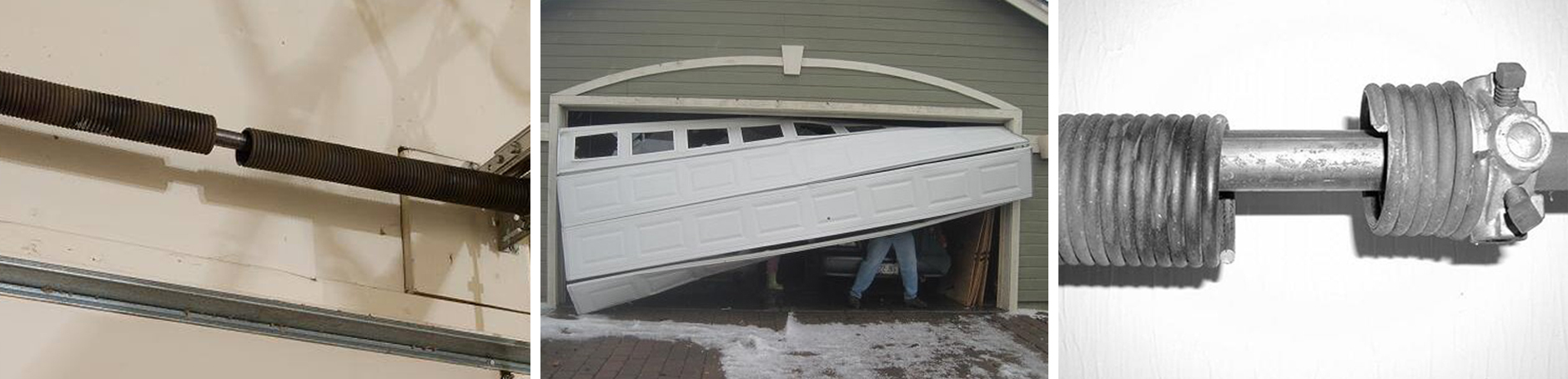
3. You Notice a Gap in the Spring
This one’s easy to spot if you know where to look. Your torsion springs sit on a metal shaft directly above the garage door when it’s closed. Walk into your garage, look up, and examine the springs. A healthy spring is tightly wound with no visible gaps between the coils.
If you see a noticeable gap in a torsion spring, the spring has most likely already broken. A torsion spring is tightly wound when intact; when it breaks, the coil separates and leaves a visible gap. Do not attempt to touch, adjust, or replace it yourself. Garage door springs are under significant tension and should be serviced by a trained professional.
4. Your Opener Is Straining
Your garage door springs do most of the heavy lifting. They counterbalance the weight of the door so the opener can raise and lower it without excessive effort. When the springs weaken, the opener has to pick up the slack — and it wasn’t designed to carry that extra load.
Signs your opener is straining: the motor runs longer than usual before the door fully opens, you hear the motor laboring (a louder, higher-pitched hum), the door stops partway and reverses, or the opener feels warm to the touch after operating. Some newer openers will flash an error code or refuse to operate if the resistance exceeds their safety threshold.
If you’re burning through openers every few years, the problem might not be the opener at all. It might be worn springs forcing the motor to overwork.
5. The Door Makes a Loud Creak or Bang When Opening
Garage doors are never silent machines, but there’s a difference between normal operational noise and a sudden or unusual sound. A damaged spring or other garage door component may produce a metallic groan, pop, or bang during operation.
Not every squeak or creak means you have a spring problem. But if your door suddenly starts making noises it didn’t make before — especially popping or banging sounds — it’s worth having the system inspected.
6. The Door Slams Shut Instead of Closing Gently
A properly balanced door with healthy springs closes in a controlled, even descent. If your door drops the last foot or two with a thud, or if it closes noticeably faster than it used to, the springs aren’t providing enough counterbalance to control the weight on the way down.
This is a safety issue, not just a convenience problem. A heavy garage door dropping unexpectedly can damage the floor, bottom seal, tracks — and, more importantly, seriously injure a person or pet underneath it. If your door is slamming shut, address it immediately.
7. Your Springs Are Just Old
Sometimes there are no dramatic warning signs. Sometimes the springs just hit their age limit. Many standard torsion springs are rated for about 10,000 open-and-close cycles. If you use your garage door four times a day, that’s about 1,460 cycles per year — enough to reach 10,000 cycles in just under seven years. Actual spring life varies depending on the spring, the door, and how often it’s used.
If your springs are original and approaching eight years old, especially on a garage door that’s used several times a day, it’s worth having them inspected. Proactive replacement on your schedule is always cheaper and less disruptive than emergency replacement on the spring’s schedule.
What To Do If You Spot These Signs
First: don’t try to fix springs yourself. We don’t say this to get your business, but because torsion springs store a tremendous amount of energy. Attempting to adjust or replace one without the proper tools and training can result in serious injury. It’s not worth the risk.
Second: call and get it looked at before the spring actually breaks. A planned spring replacement is faster, often cheaper, and far less stressful than an emergency call when your car is trapped in the garage and you’re late for work.
We replace garage door springs across the Phoenix metro area — Phoenix, Scottsdale, Mesa, Chandler, Gilbert , Tempe, Glendale, Peoria, Surprise, and Goodyear. Same-day service, 7 days a week. Give us a call at 602-495-1555.