
You already have a driveway gate — or you’re having one built — and now you want to make it automatic. That’s where we come in. Arizona’s Garage Door Doctor specializes in the automation side of gates: the motors that open and close them, the access control systems that determine who gets in, and the ongoing maintenance that keeps everything running in the Arizona heat.
We don’t build or install the gates themselves — that’s a fencing contractor’s job. What we do is turn a manual gate into an automated one, replace gate operators that have failed, upgrade outdated access control systems, and keep the whole setup working reliably year after year. Here’s what you need to know.
Gate Operators: The Motor That Makes It All Work
The gate operator — sometimes called the gate motor or gate opener — is the mechanical heart of any automated gate. It’s the piece of equipment that physically moves the gate open and closed. Choosing the right one depends on your gate type, weight, and how often you’ll be using it.
Operators for Swing Gates
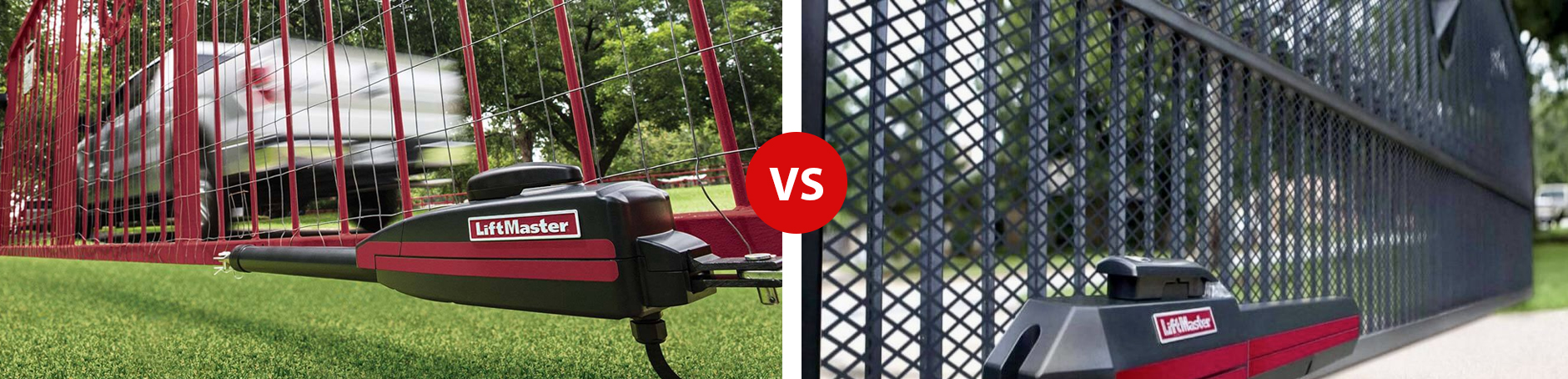
Swing gates open inward or outward on hinges. The most common operator style for residential swing gates is an arm-style operator. This mounts to a post next to the gate and connects with an articulated arm that pushes and pulls the gate open and closed.
We install arm-style operators from LiftMaster, Viking, and Linear. For most residential swing gates — up to about 16 feet wide and 500 pounds — a standard residential operator handles the job well. For heavier custom iron or steel gates, we step up to a commercial-grade operator with a more powerful motor and heavier-duty arm.
There’s also the underground operator option, which hides the motor below ground level in a housing beneath the gate’s hinge point. These are popular in Scottsdale and Paradise Valley where homeowners want automation without any visible hardware. They work well, but they’re more expensive to install and more involved to service since the motor is below grade. In the Phoenix area, we also need to account for the fact that underground housings can accumulate dust and monsoon water if not properly sealed and drained.
Operators for Sliding Gates
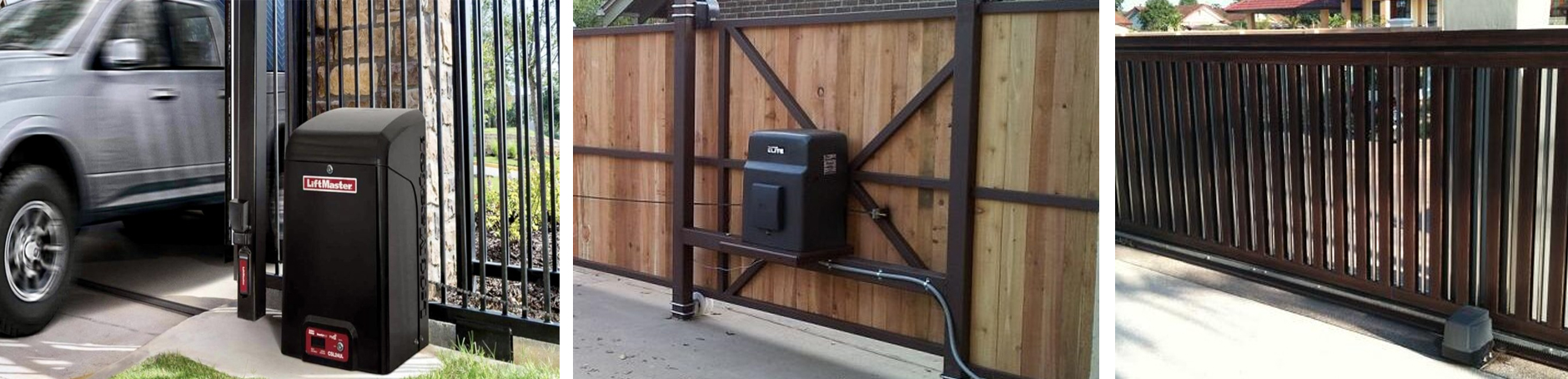
Sliding gates roll horizontally along a track. The operator for a sliding gate uses a chain-drive or rack-and-pinion mechanism mounted at the base of the gate. It’s the same proven technology used on commercial and industrial gates — reliable, powerful, and straightforward to maintain.
We install sliding gate operators from LiftMaster, Viking, Linear, and DKS. The key consideration is matching the operator’s power rating to the gate’s weight and length. An undersized operator will strain, overheat, and fail prematurely — especially in the Phoenix summer when ambient temperatures already push motors harder.
Operators for Bi-Fold Gates
Bi-fold gates fold in half as they open, requiring much less clearance than a full swing gate. These have become more popular in the Phoenix area over the past few years, especially on properties where space is tight. We install a number of these each year in Gilbert and Chandler, where lot sizes often leave no room for a full swing. The operator for a bi-fold gate is typically a top-mounted system that lifts and folds the gate simultaneously. These are specialized units and require precise installation to operate smoothly.
How the Phoenix Climate Affects Gate Operators
Gate operators in the Phoenix area work harder than in most places. Here’s why that matters and what we do about it:
Heat stress on motors: An operator mounted on a south-facing pillar in direct sun can reach internal temperatures well above what the manufacturer designed for. The motor runs hotter, the lubricant thins out faster, and electronic components age prematurely. Wherever possible, we position operators in shade — behind a pillar, under an overhang, or with a sunshade installed over the housing. When shade isn’t an option, we specify operators with higher thermal ratings.
Dust and debris: Desert dust, sand, and gravel accumulate in tracks, chain mechanisms, and operator housings. For sliding gates, a dirty track is the number one cause of premature wear. For swing gates, dust in the arm joints causes grinding and stiffness. Regular cleaning — even just hosing down the track and wiping the arm joints every few months — extends the life of the equipment significantly.
Monsoon season: Our monsoon storms bring sudden, heavy rain, wind-blown debris, and power outages. Gate operators need to be properly weatherproofed — sealed housings, protected wiring connections, and drainage around underground installations. Power outages are also a real concern, which brings us to battery backup.
Battery Backup: Don't Skip This in Phoenix
We strongly recommend battery backup on every gate operator we install. Here’s the scenario: it’s monsoon season, the power goes out at 6pm, and you’re stuck on the wrong side of your own gate. Without battery backup, you have to manually release the operator and physically push the gate open — which, depending on the gate’s weight, ranges from annoying to genuinely difficult.
A battery backup system keeps the operator running normally during a power outage. Most residential battery backups provide enough power for 50 to 100 open-and-close cycles, which can keep you going for days during an extended outage. LiftMaster’s integrated battery backup is the system we install most frequently — it charges automatically when power is on and switches over seamlessly when power drops.
Access Control: How You and Your Guests Get In
The access control system is where gate automation has evolved the most in recent years. Twenty years ago, your options were a remote control or a keypad. Today, you can control your gate from anywhere in the world with your phone. Here’s what’s available:
Keypads
Still the most common and most affordable option. You set a code, punch it in, and the gate opens. Modern keypads are backlit, weatherproof, and support multiple codes — which is useful because you can set a permanent code for your household and a temporary code for a contractor or house guest. When the job is done or the guest leaves, you delete their code without changing yours.
Keypads are reliable in the Phoenix climate, but the sun does take a toll on the buttons over time. Budget for a keypad replacement every 5 to 7 years, or choose a metal-button model that holds up better than rubber-button versions.
Remote Controls
A dedicated handheld remote works much like a garage door opener remote. Press the button in your car, the gate opens. Simple and convenient for daily use. The main downside is managing multiple remotes for family members and replacing batteries periodically. We usually recommend a remote as a backup to smartphone control rather than the primary access method.
Smartphone Control
Smartphone control has become one of the most popular options for our customers. An internet-connected access system lets you open and close the gate from your phone — from your driveway, your office, or another state. You can let in a delivery driver, a house cleaner, or a visiting family member without being home.
LiftMaster’s myQ system is the one we install most frequently. It gives you real-time notifications when the gate opens, a log of every access event, and the ability to grant and revoke access for specific people. For homeowners who travel frequently or manage rental properties, smartphone control can be especially useful.
Video Intercom
A video intercom at the gate lets you see and speak with visitors before buzzing them in. Modern intercom systems connect to your smartphone, so you can answer the intercom from anywhere — your couch, your office, or a different city. When a delivery driver, repair technician, or unexpected visitor arrives, you see them on your phone and decide whether to open the gate.
Video intercoms are especially popular with our Scottsdale and North Phoenix customers. They add both security and convenience and they pair well with smartphone control for a fully connected system.
Card Readers and Key Fobs
More common on commercial or multi-tenant properties, but some homeowners use them too. A card reader or fob system works like a hotel key — tap the card, the gate opens. These are useful in situations where you need to track access by individual (who entered and when) without sharing codes.
Upgrading an Existing Gate System
If you already have an automated gate with an older operator, you don’t necessarily need to replace everything. In many cases, we can:
Replace just the operator: If your gate is in good shape but the motor has died or is unreliable, we can swap the operator without touching the gate. This is the most common service call we get — a 10- to 15-year-old operator that’s reached the end of its life.
Add access control to an existing system: If your current operator works fine but you only have a basic remote, we can add a keypad, smartphone control, or intercom to the existing setup. This is a popular and cost-effective upgrade.
Upgrade the operator and add modern access control at the same time: If both the motor and the access system are outdated, replacing everything together is the most efficient approach. We can match a new LiftMaster or Viking operator with a full myQ smartphone control system in a single installation visit.
Maintenance: What Your Gate Automation System Needs
An automated gate in Phoenix isn’t a set-it-and-forget-it installation. The desert environment requires regular attention to keep the system running reliably:
Quarterly: Clean the track (sliding gates) or hinge points (swing gates). Remove dust, sand, rocks, and any debris that has accumulated. Wipe down the operator housing.
Twice a year: Lubricate the chain or arm mechanism, check the operator’s force settings, test the auto-reverse safety feature, and inspect wiring connections for heat damage or critter intrusion (rodents love chewing wires in the desert).
Annually: Full professional inspection. We’ll go through the entire system — operator, access control, battery backup, safety devices, gate balance, and hardware. We catch problems early, before they become emergency repair calls.
If you’ve inherited a gate system with a house purchase and you’re not sure when it was last serviced, call us for an inspection. We see a lot of systems that haven’t been touched in years — and a tune-up now prevents a breakdown later.
When to Call a Professional
Gate operators involve heavy equipment, high-tension springs (on some systems), and electrical wiring. Adjusting force settings, replacing motors, and working on access control wiring should be done by a trained technician. A miscalibrated force setting can cause a gate to not reverse when it encounters an obstruction — which is a serious safety risk, especially for families with children or pets.
If your gate is making unusual noises, moving slower than it used to, reversing when it shouldn’t (or not reversing when it should), or if the operator is unresponsive to remotes or keypads, give us a call at 602-495-1555. We service automatic gate systems across the entire Phoenix metro — Phoenix, Scottsdale, Mesa, Chandler, Gilbert , Tempe, Glendale, Peoria, Surprise, and Goodyear. Same-day service, 7 days a week.