
Buying a garage door in Arizona isn’t like buying one in Ohio. In most parts of the country, a garage door’s job is fairly simple — keep the weather out, look decent, and open when you press the button. Here, your garage door has to survive surface temperatures that can hit 160 degrees on a south-facing wall, UV exposure that degrades materials in a fraction of the time, and daily temperature swings of 30 to 40 degrees that expand and contract every component, every single day, for years.
We’ve been installing and repairing garage doors in the Phoenix metro for over 25 years, and we’ve seen what holds up and what doesn’t. Here’s what actually matters when choosing a garage door for an Arizona home.
Insulated vs. Non-Insulated: Understanding the Tradeoffs
Insulation is one of the first things people ask about when shopping for a garage door in Arizona, and for good reason. But the conversation is more nuanced than most articles make it seem. An insulated door isn’t a magic fix for a hot garage — it’s one piece of a bigger picture.
Here’s what an insulated garage door actually does: it slows heat transfer through the door itself. When the sun is beating down on your garage door at 115 degrees, an insulated door reduces the amount of that heat that passes through to the inside compared to a single-layer steel panel. That’s a real benefit, and it’s worth having.
But here’s what most people don’t consider: your garage door is just one surface. If the walls and ceiling of your garage aren’t insulated — and in many Phoenix homes, especially older construction, they aren’t — heat is coming in from every direction, not just the door. Installing a high-R-value door on a garage with uninsulated walls and an uninsulated ceiling is like putting on a winter coat but wearing shorts. It helps, but it doesn’t solve the whole problem.
There’s also a tradeoff that rarely gets mentioned: insulated doors trap heat in both directions. If you park a hot car in your garage after driving in 115-degree heat, an insulated door holds that heat inside the garage longer than a non-insulated door would. Think of it like an oven — insulation keeps heat out when it’s hotter outside, but it also keeps heat in when the heat source is inside the garage. For most homeowners this isn’t a dealbreaker, but it’s worth knowing.
Our recommendation for most Phoenix homes falls in the R-6 to R-12 range. That provides meaningful heat transfer reduction without over-engineering for a non-climate-controlled space. If your garage is air-conditioned — which some homeowners do for workshops or home gyms — then a heavily insulated door in the R-16 to R-18 range makes sense because you’re actually trying to maintain a controlled temperature. For a standard garage, R-6 to R-12 hits the sweet spot between performance and cost.
Steel Doors: The Best All-Around Choice for Phoenix
Steel is the most popular garage door material in Arizona, and for good reason. Modern steel doors resist dents better than older models, they don’t warp in the heat, they won’t rot or delaminate, and they require almost zero maintenance beyond occasional cleaning. They’re also available in a huge range of styles — traditional raised panel, carriage house, flush contemporary, and everything in between.
The key spec to look for on a steel door is the gauge of the steel (lower numbers are thicker and more durable) and the insulation R-value. For Phoenix, we generally recommend at least R-6 as a baseline, with R-12 being ideal for attached garages that share a wall with living space or garages that face south or west where sun exposure is highest.
We install steel doors from Amarr, Clopay, and Wayne-Dalton — all three make excellent doors for the Arizona climate. Each brand has different strengths: Amarr offers strong mid-range value, Clopay has the widest style selection, and Wayne-Dalton is known for durability.
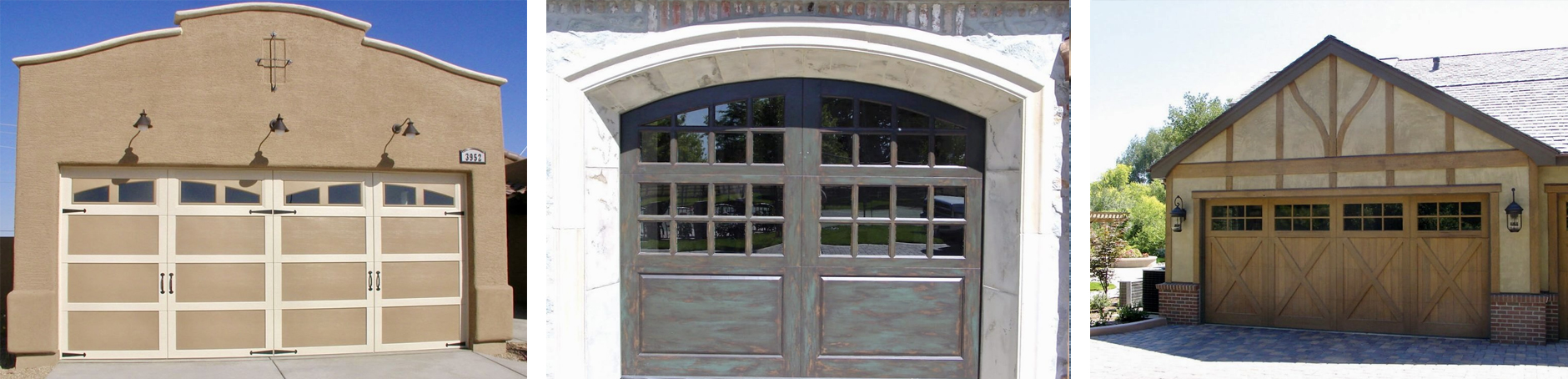
Wood Doors: Beautiful, But High-Maintenance Here
We’re not going to tell you wood garage doors don’t look incredible — they do. A real wood carriage-style door on a Southwest or Spanish-style home is stunning. But in the Phoenix area, wood requires a level of commitment that most homeowners underestimate.
Wood expands and contracts aggressively in our temperature swings. The UV exposure causes stain and sealant to break down in 1 to 2 years instead of the 3 to 5 years you’d get in a cooler climate. Unfinished or poorly maintained wood will crack, warp, and split. And desert dust embeds itself in the grain, making cleaning a chore.
If you love the look of wood, consider a steel door with a wood-grain finish. Modern manufacturing has gotten remarkably good at mimicking the look of real wood — from a distance of more than a few feet, most people can’t tell the difference. You get the aesthetic without the maintenance, the warping risk, or the UV degradation. We show these options to Scottsdale and Paradise Valley homeowners all the time, and the reaction is almost always surprise at how realistic they look.
Aluminum and Glass Doors: The Modern Look
Full-view aluminum and glass doors — the kind you see on contemporary homes and in architectural magazines — have become increasingly popular in the Phoenix area, especially in Scottsdale, Arcadia, and Tempe’s newer builds. They look sharp and let natural light into the garage.
The concerns are valid: will the glass turn the garage into a greenhouse? The answer depends on the glass type. Tempered, tinted, or frosted glass with UV protection performs well. Clear, non-treated glass will absolutely cook your garage and fade everything inside it. If you’re considering this style, make sure the glass spec is appropriate for southern exposure in a desert climate.
Aluminum frames hold up well in the heat — better than steel in terms of corrosion resistance, though they dent more easily. These doors are typically at the higher end of the price spectrum, but for the right home, the visual impact is worth it.
How Much Insulation Do You Actually Need?
You’ll see R-values thrown around a lot when shopping for garage doors. Here’s a practical guide for Phoenix based on what we’ve seen work best over 25 years:
R-6 to R-8: A solid baseline for most Phoenix garages. This provides meaningful heat transfer reduction through the door and is the minimum we’d recommend for any Arizona home. Good for detached garages and garages that don’t share walls with living spaces.
R-8 to R-12: The sweet spot for most attached garages. If your garage shares a wall with your living room, bedroom, or kitchen, this range slows enough heat transfer to make a noticeable difference — especially if the shared wall is also insulated. This is where most of our Phoenix installations land.
R-16 to R-18: Designed for air-conditioned garages. If you’ve invested in climate control for your garage — a workshop, home gym, or flex space — then a heavily insulated door makes sense because you’re trying to maintain a set temperature. For a standard non-AC garage, you’re paying a premium for insulation that won’t deliver proportionally more benefit.
Keep in mind: the door’s R-value is only part of the equation. If you’re serious about managing garage temperature, look at the whole envelope — walls, ceiling, and weathersealing around the door. A well-sealed R-8 door on a garage with insulated walls will outperform a poorly sealed R-16 door on a garage with bare drywall and gaps around the frame.
Color Matters More Than You Think
Dark-colored garage doors absorb significantly more heat than light-colored ones. A dark brown or black door on a south-facing wall can reach surface temperatures 30 to 40 degrees higher than a white or light tan door in the same sun. That heat transfers through the door and into your garage.
If your garage faces south or west, consider lighter colors — not just for heat reasons, but for the door’s longevity. Dark paint fades and chalks faster under intense UV. Light colors maintain their appearance longer with less maintenance.
That said, if your HOA requires a specific color or your home’s aesthetic demands a darker tone, an insulated door will offset some of the heat absorption. Just don’t pair a dark color with a non-insulated door — that’s the worst combination for the Arizona climate.
Our Recommendation
For most Phoenix-area homes, the best garage door is a two- or three-layer insulated steel door in the R-6 to R-12 range, a light or mid-tone color, and proper weathersealing all around. It’s the combination that performs best in our climate, requires the least maintenance, and gives you the broadest range of style options.
If your garage is air-conditioned or you’re building a climate-controlled workspace, invest in a higher R-value door — R-16 or above — where the insulation will actually work in concert with your cooling system. And regardless of which door you choose, make sure your installer pays attention to the weathersealing around all four sides of the opening. The best door in the world can’t do its job if hot air is leaking in around the edges.
If you’re ready to explore options for your home, call us at 602-495-1555 or stop by our offices in Tempe or Gilbert. We carry Amarr, Clopay, and Wayne-Dalton doors and can show you samples in person. We serve the entire Phoenix metro — Phoenix, Scottsdale, Mesa, Chandler, Gilbert , Tempe, Glendale, Peoria, Surprise, and Goodyear.